


How to Plan One Slow Week in Tuscany (Without Seeing Everything)

Updated: Sep 8
This article contains affiliate links. If you book through one of these links, Truly Italy may earn a commission at no additional cost to you.
A friend once booked a week in Chianti, Tuscany, and asked me to help shape it.
I planned exactly one thing a day for them.
That was it.
From driving between Tuscan villages to tasting wine, they were exhausted by late afternoon. But because the days weren’t crammed, they still had energy for:
Wandering the town in the evening
Long dinners at little places they loved
Actually talking to each other and to locals
New to this approach? Start with my complete guide to Slow Travel in Tuscany.
Another friend took my “one base, slow week in Tuscany” advice and planned her own version. After the trip, she told me:
“We were able to get to know the town and the locals without feeling like we had to keep doing more. It actually felt like we were on vacation.”
That’s the whole point.
Depth of a place and feeling beats distance.
One base in the right place can give you more than five cities on one trip.
Here’s how to plan one slow week in Tuscany step by step.

Step 1: Choose One Base in Tuscany
When I say “base,” I don’t mean a giant resort.
I mean a small town or village in Tuscany that has:
A bar (café)
A tiny grocery or alimentari (deli)
A pharmacy (farmacia)
A couple of places to eat
And, if you’re lucky, a beautiful overlook on a hill
You want reachable day trips within 30–60 minutes, and you want it to be somewhere you’d actually be happy to stay on a do-nothing day.
That last part matters. On a true slow week, there will be a day where you don’t feel like going anywhere. Your base needs to be somewhere that still feels nourishing and relaxing when you stay put.
Read more on One Base in Tuscany here.
Suggested Areas for Your Tuscany Itinerary
Here are a few areas to look at for your Tuscany itinerary:
Radicondoli – my current favorite small hill village in Tuscany
A southern Chianti village – away from Florence, with real countryside around you toward Castelnuovo Berardenga
Maremma – closer to the sea and Grosseto, quieter and more “middle of nowhere”
Garfagnana – north of Lucca, green and mountainous (friends of mine rave about it)
You don’t need the “perfect” town. You need a good-enough village in Tuscany in a good-enough area, with life happening around you.
Step 2: Set a Simple Weekly Rhythm for Your Slow Week in Tuscany
Once you have your base, the magic is in the rhythm. A slow week in Tuscany isn’t about what you squeeze in. It’s about how your days feel.
Here’s the rhythm I use for myself and for my small-group Tuscany trips:
Slow Mornings
Walk to the bar. Order a coffee. Enjoy a simple breakfast. No rush. Let yourself remember what it feels like not to wake up to an alarm and a to-do list.
One Main Thing Per Day
Not five. Just one:
A local market
A nearby hill town
A winery visit
A countryside walk
A new bar or café in the next town over
Everything else is optional.
Want to add a cooking experience to your week? A hands-on cooking class can be a wonderful way to slow down and connect with Tuscan food and local traditions. If you're staying around Siena, you can browse cooking experiences in Siena and the surrounding countryside.
Built-In Breathing Room
Time to sit, read, journal, or nap. Time to actually absorb where you are.

Unhurried Evenings
You’re allowed to go back to the same restaurant twice. Or three times. You’re allowed to be the last ones at your table.
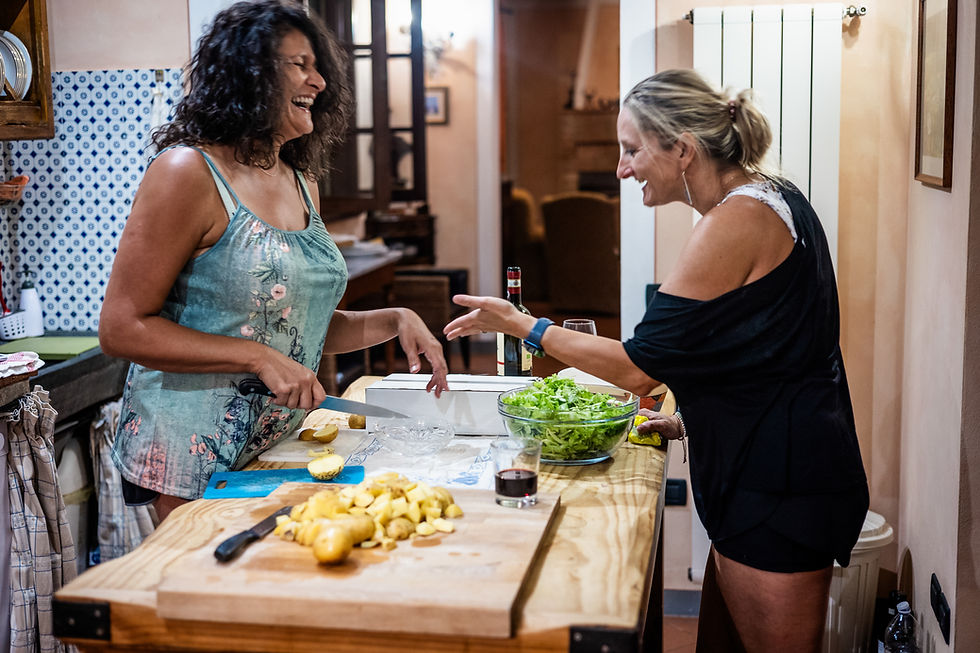
Some nights in Radicondoli, Stefano and I have stayed so long that we only realized it was late when they started cleaning up. Aperitivo turned into dinner, which turned into dessert and grappa, leading to real connections with the staff. It was perfect.
What One Slow Day Looked Like for Us
On our last trip to Radicondoli, one day looked like this:
We slept in until 9 (late for us).
Had a slow, late breakfast.
Left the house around 11 for “a quick walk” that turned into an hour-long hike around the town.
Came back starving, made a big lunch, and then… rested.
We napped.
Read our books.
I journaled and tried to sketch.
In the evening, we wandered down to the bar for aperitivo and then had dinner with our favorite locals at the same place we’d been before.
That’s it. No checklist. But it’s one of the days I remember most clearly.
A Sample 7-Day Slow Tuscany Itinerary
Here’s what a 7-day slow week in Tuscany might look like:
Day 1: Arrive, unpack, gentle walk around the village.
Day 2: Visit a nearby town.
Day 3: Winery visit + countryside drive.
Day 4: Rest day in the village (errands, shops, pharmacy, casual conversations).
Day 5: Bigger trip day (Siena, Florence, Lucca… depending on your base).
Day 6: Market day / second winery / more wandering.
Day 7: Soft, easy departure.
The key: one main thing a day, plus permission to repeat what feels good.
If a restaurant made you feel cared for, go back. If a certain walk felt like therapy, do it again.
Step 3: Reality-Check the Logistics of Your Tuscany Trip
This is where a lot of slow-week plans fall apart. A few simple questions for your Tuscany travel planning:
Car or No Car?
A car makes sense when:
You’re staying in a small village like Radicondoli
You’re in the countryside with limited public transport
Skip the car when:
You’re based in or very close to a city like Florence
You can easily reach other towns by train, tram, or bus
Realistic Drive Times in Tuscany
From your base to a nearby hill town: → 20–45 minutes
To bigger cities or coastal areas: → 60–90 minutes
Remember: Tuscan roads are not straight highways. They’re winding, bendy, and sometimes under construction. You might get a little lost. That’s okay. Just don’t plan these day trips like a rush from one place to another.
Ready to rent a car for Tuscany?
If you’re planning to explore Tuscany’s smaller villages and countryside, having a car gives you much more freedom to travel at your own pace.
One Big Rule
Don’t move bases or do big transfers at night. Night-time drives on unfamiliar, unlit roads when you’re tired are just not worth it. Arrive and move in daylight whenever you can.
Step 4: Protect the “Slow” When You’re Tempted to Add More
At some point, you’ll be tempted to add:
“Just one more” city
“Just one more” activity
“Just one more” excursion
Before you do, ask:
“Will this make our week feel deeper, or just busier?”
Everything you add comes with a cost: getting there and getting back, more decisions, and more energy. You’re on vacation. You should be relaxing, not running from thing to thing.
It’s more than okay to leave days lighter on purpose. Those are often the days when you:
Sit on a bench and listen to the i nonni (grandparents) talk about their day
End up having a long, unexpected conversation with a barista
Discover a tiny corner of the village that feels like yours
Those are the moments you’ll remember.
A Quick Recap: How to Plan One Slow Week in Tuscany
To plan one slow week in Tuscany:
Choose one good base (a small town or village in Tuscany)
Set a simple weekly rhythm: slow mornings, one main thing, unhurried evenings
Reality-check the logistics: car vs no car, real drive times, daylight moves
Protect the breathing room when you’re tempted to add more
This is how I plan my own time in Tuscany. It’s also how I design my upcoming week-long village trips in Italy. You don’t need the “perfect” Italy itinerary. You need a week that your body, your nervous system, and your relationships can actually enjoy.
If You Want Help Putting This into Practice
New here? Start with my free Slow Tuscany Starter Kit. Download it here
If you’re a DIY planner and want a ready-made version of what I’ve described here, my Slow Week in Tuscany guide is a complete 7-day, village-based itinerary you can adapt to your own dates and travel style.
You can find it here: Slow Week in Tuscany guide
If your current Italy itinerary already feels like a marathon and you want help reshaping it, you can book a 60-minute Slow Italy Trip Planning Session with me. We’ll look at your route, bases, and days together and turn it into something slower and more realistic.
More about sessions here: Slow Italy Trip Planning
And if you’d rather have someone hold all of this for you in person, I’m designing a June 2027 Tuscan village week for a tiny group of 8 guests. It’s the live, in-person version of everything I’ve just written about.
You can quietly join the interest list here: Tuscan Village Experience


Comments